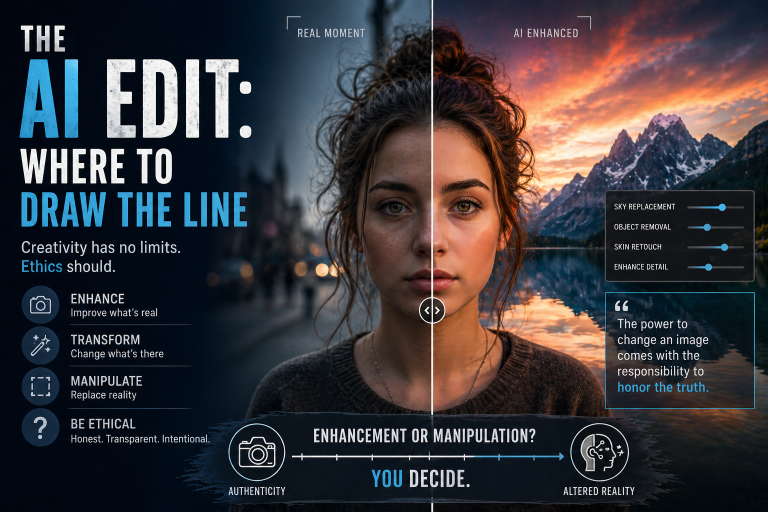
Artificial intelligence has quietly, then suddenly, become one of the most powerful tools in a photographer’s workflow. What once took hours in post-production can now be done in seconds. Skin retouching, sky replacement, object removal, and even full scene reconstruction are all possible with a few clicks. But just because something can be done does not mean it always should be.
The question photographers are now facing is not whether to use AI. That decision has already been made for most. The real question is where to draw the line.
Enhancement vs. Manipulation
Photography has never been purely objective. Darkroom techniques have been part of the craft since the beginning, and digital editing has been standard practice for decades. Adjusting exposure, correcting color, and refining contrast are widely accepted as part of the process. These adjustments enhance what was already present in the scene.
AI introduces a different level of control. It does not just enhance, it can generate. A flat sky can become dramatic. A distracting background can disappear. A subject’s expression can be subtly altered. At a certain point, the image begins to shift away from documentation and toward creation.
For many photographers, the distinction comes down to intent. Are you clarifying what was there, or replacing it with something new?
Client Expectations Are Changing
Clients are increasingly drawn to images that look polished and refined. In many cases, they expect it. Smooth skin, perfect lighting, and clean backgrounds have become the norm rather than the exception.
At the same time, there is a risk in pushing too far. Images that are overly perfected can start to feel artificial. In areas like documentary work, lifestyle branding, and even personal portraits, authenticity often carries more weight than perfection.
Clear communication is essential. Photographers need to define their approach and explain it to clients. Setting expectations early helps avoid misunderstandings and ensures that the final images align with both artistic intent and client goals.
The Ethical Divide
In certain areas of photography, the boundaries are firm. Photojournalism and documentary work depend on trust. Viewers expect that what they are seeing reflects reality. When AI is used to alter that reality, the credibility of the image is compromised.
Outside of those fields, the lines are less defined but still important. Questions are beginning to surface about disclosure and transparency. If an image has been significantly altered, should that be communicated? If elements have been added or removed, is it still accurate to call it a photograph?
There is no universal standard yet, but the conversation is ongoing and evolving.
Social Media and the Illusion of Reality
Platforms like Instagram have accelerated the rise of highly polished imagery. Feeds are filled with images that appear flawless, often blending photography and digital creation in ways that are difficult to distinguish.
This environment creates pressure. Viewers become accustomed to a certain level of perfection, and photographers feel the need to meet those expectations. Over time, the baseline shifts.
At the same time, there is growing interest in work that feels more genuine. Imperfection, spontaneity, and honesty are becoming more valued in response to overly refined imagery.
Defining Your Own Line
There is no single rule that applies to everyone. Each photographer must decide where they stand based on their work, their clients, and their values.
Some fully embrace AI as part of their creative process. Others use it sparingly or avoid it altogether. Most find a balance somewhere in between.
What matters is consistency and intention. Understanding why you are making certain choices helps ensure that your work remains authentic to your vision.
The Future of the Image
AI will continue to evolve and become more integrated into photography. The challenge is not simply learning how to use these tools, but understanding when and why to use them.
Photography has always been shaped by technology, but it is ultimately defined by the decisions behind the lens and in the editing process. In a time when almost anything is possible, those decisions carry even greater weight.
The line may not be fixed, but it is always there.