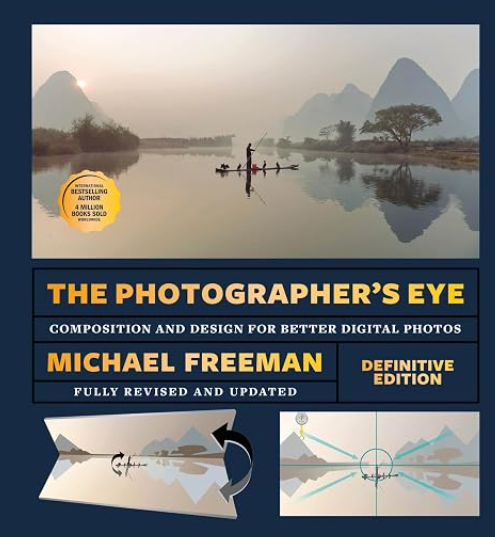
Michael Freeman’s The Photographer’s Eye – Definitive Edition: Composition and Design for Better Digital Photos is an insightful and practical examination of one of photography’s most important skills: learning how to see. While cameras, lenses, and editing software continue to change, Freeman argues that strong composition remains essential to creating meaningful and visually effective photographs. Rather than focusing primarily on technical settings, the book explores how photographers organize the elements within a frame and make deliberate visual decisions.
One of the book’s greatest strengths is Freeman’s ability to explain composition as a flexible creative process rather than a collection of strict rules. Familiar concepts such as the rule of thirds, leading lines, balance, symmetry, contrast, perspective, and framing are discussed, but Freeman does not present them as formulas that guarantee a successful photograph. Instead, he encourages readers to understand why these techniques work and when they may be ignored or intentionally broken. This approach makes the book useful for photographers who want to move beyond simply following standard guidelines.
Freeman also pays close attention to how the human eye responds to visual information. He examines how viewers naturally follow lines, recognize patterns, notice contrast, and search for points of interest. By understanding these tendencies, photographers can create images that guide the viewer through the frame. The book demonstrates that composition is not just about placing a subject in an attractive location. It is also about controlling visual emphasis, removing distractions, establishing relationships between objects, and deciding what should be included or excluded.
The visual examples are particularly effective. Freeman uses a wide variety of photographs to illustrate how different compositional choices affect the final image. In many cases, he analyzes the decision-making process behind a photograph, showing how changes in camera position, timing, cropping, or focal length can alter the result. These examples help readers understand that successful images are often created through careful observation and repeated adjustment rather than luck.
Another valuable aspect of the book is its emphasis on digital photography. Digital cameras allow photographers to review images immediately, experiment with multiple compositions, and refine photographs through post-processing. Freeman acknowledges these possibilities while maintaining that editing cannot replace thoughtful image-making. Cropping and tonal adjustments may improve a photograph, but the strongest images usually begin with a clear visual idea at the moment of capture.
At times, the book contains a large amount of visual theory and terminology. Beginning photographers may need to read certain sections slowly, especially when Freeman discusses complex ideas involving geometry, rhythm, movement, and visual weight. Some readers may also find the analytical style more academic than inspirational. However, this depth is one of the reasons the book remains valuable. It encourages photographers to think carefully about what they are doing rather than relying entirely on instinct or equipment.
The definitive edition is especially useful because it brings together Freeman’s established principles of photographic design in a polished and comprehensive format. It can be read from beginning to end, but it also works well as a reference book that photographers can revisit when facing a compositional challenge.
Overall, The Photographer’s Eye is an excellent resource for anyone interested in creating stronger photographs. Freeman makes it clear that better photography does not necessarily require more expensive equipment. It requires patience, awareness, curiosity, and the ability to recognize visual possibilities. The book teaches readers to slow down, study the frame, and make purposeful choices. For beginner and experienced photographers alike, it offers a thoughtful guide to transforming ordinary scenes into photographs that are organized, engaging, and visually memorable.