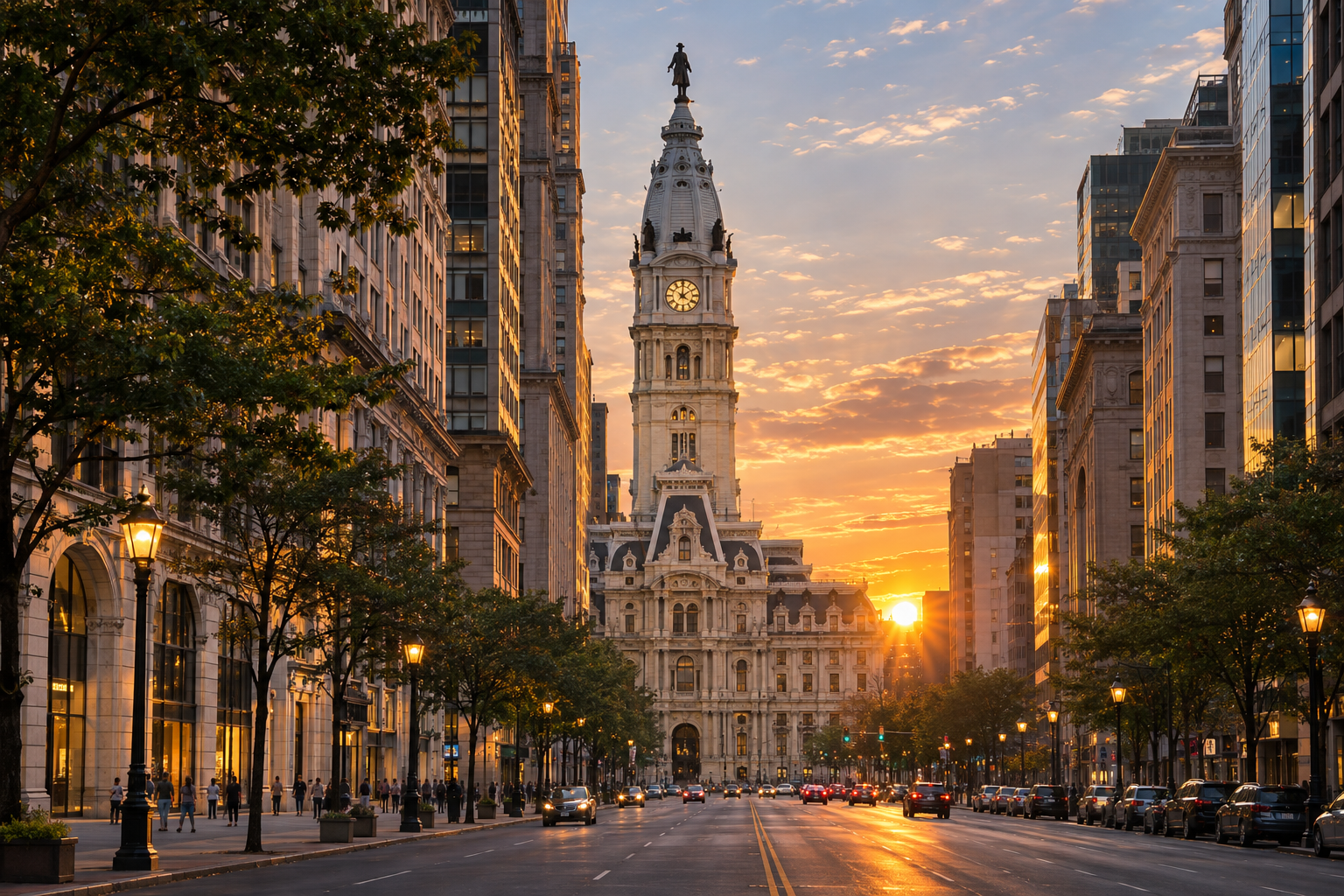
For a few minutes around sunset, the view down Market Street can change from one block to the next. Stand at a corner with a clear view west and the sun appears low between the buildings, bright enough to turn windshields and shop windows into mirrors. Move farther down the sidewalk and a façade may hide it altogether. That brief alignment, known as Phillyhenge, brings photographers to Center City in early April and again around the beginning of September.
The effect depends on the angle of the street and where the sun sets on the horizon. That point shifts through the year. When it lines up with Market Street, the long rows of buildings give the light a straight path through the city. New York has a similar phenomenon known as Manhattanhenge, but Philadelphia’s version has a landmark of its own. Around City Hall, the clock tower and the building’s ornate stonework give photographers a recognizable point of reference as the rest of the scene changes around them.
Market Street is a good starting point, particularly where several blocks are visible in one direction. The view from a busy intersection can be dramatic, but it can also leave little room to work. Walking the area before sunset gives you time to find a clear view from the sidewalk and see what each corner offers. On one block, a row of windows might pick up the light. On another, a gap between buildings might let you include more of the sky. A nearby side street or an elevated public vantage point can give you a different picture of the same evening.
Check the local sunset time and plan to arrive 30 to 45 minutes beforehand. That gives you time to settle on a position, try a few compositions, and see where the shadows are falling. Look west as you scout. Clouds overhead may have little bearing on the shot if the horizon is clear, while a low bank of clouds can cover the sun just as the alignment begins. A break in the clouds may give you only seconds to make an exposure.
You can photograph Phillyhenge with whatever camera you already carry. A longer lens lets you isolate the sun and the distant buildings, making the layers of the street appear closer together. A wide-angle lens takes in the sidewalks, traffic, and buildings immediately around you. If the wider frame feels busy, look for one foreground element to give it structure. A person waiting at a crosswalk or a streetlamp against the bright sky can give the eye somewhere to start.
The contrast can be sharp enough that one exposure gives you a bright sky and very little detail at street level. Manual exposure helps keep a sequence consistent as cars and people pass through the frame. If you want detail in both the sky and the buildings, try bracketing a few exposures while the light holds. You can also expose for the sky and let the foreground fall into silhouette. A person crossing the street can be more readable as a dark outline than as one more detail in a crowded frame.
It’s worth watching what happens after the sun slips out of direct view. The light may linger on upper floors while the street below is already in shadow. A bus can carry a strip of reflected color across the frame, and a window on a side street can hold the last bright patch of sky. When the sidewalks around City Hall are crowded, stepping away from the main group gives you room to notice those smaller changes and make a photograph from your own point of view.
The alignment can be planned around, but the picture itself is harder to predict. Weather, traffic, and the people passing through the light all shape what you see. You might go home with the photograph you had in mind when you left the house. You might find your best frame on the walk back, one block over, after the sun has already disappeared.
In 2027, look for Phillyhenge around April 6–9 and again September 3–4. For a view down Market Street, pick a spot facing west and arrive 30 to 45 minutes before sunset. The clearest view will depend on your block and the cloud cover near the horizon.