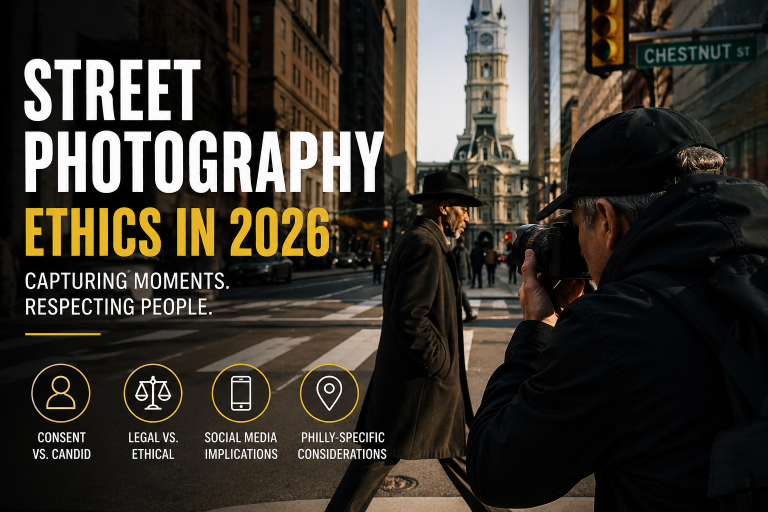
Street photography has always walked a fine line but in today’s hyper-connected, AI-driven world, that line is getting thinner. The camera that once froze a decisive moment now feeds an algorithm. The stranger you photographed on Market Street might find their face in a training dataset before they’ve made it home. The old debates haven’t gone away. They’ve just gotten more dangerous.
Consent vs. Candid Moments: The Original Sin
The soul of street photography is the unposed truth a grief-stricken face, a joyful collision of strangers, a quiet moment swallowed by a loud city. Ask for permission, and you kill the moment. Don’t ask, and you’ve made a choice for someone who never agreed to be your subject.
For decades, photographers hid behind the defense of “public space.” If you’re in public, you have no reasonable expectation of privacy. Legally, that still holds in most jurisdictions. Ethically, it’s aging badly.
The difference now is what happens next. In 1975, Henri Cartier-Bresson’s subject might never know they appeared in a magazine. In 2026, that same image shot on a mirrorless camera, uploaded within minutes, tagged with a location can be reverse image-searched, run through facial recognition, and linked to someone’s LinkedIn profile before lunch. Candid is no longer just candid. It’s permanent, searchable, and potentially exposing.
The honest question every street photographer must ask isn’t “Do I have the right to take this?” It’s “Do I have the right to keep it?”
Social Media Implications: Virality as Violence
Posting street photography online used to mean sharing with an audience of fellow enthusiasts. Now it means entering a content ecosystem designed to amplify emotional extremes. A photo of a person having a breakdown, a couple mid-argument, a kid mid-fall these aren’t just compelling images anymore. They’re kindling.
Viral street photography can destroy lives before the subject even knows the shutter clicked. The platforms profit. The photographer gets followers. The subject gets nothing except, sometimes, harassment. This is not a hypothetical. It’s happened repeatedly, and the pace is accelerating.
Photographers who post publicly in 2026 are, functionally, publishers. That responsibility is real whether or not they acknowledge it.
Legal vs. Ethical Boundaries: The Growing Gap
Here’s the uncomfortable truth: you can be entirely within your legal rights and still be doing something wrong.
U.S. law remains broadly permissive for photography in public spaces. Pennsylvania has no specific statute restricting street photography. You can photograph strangers, protests, police, and private buildings’ exteriors without consent. The law won’t stop you.
But legality is a floor, not a ceiling. What the law permits and what a person of conscience should do have always been different categories and that gap is widening as technology evolves faster than legislation can follow.
AI scraping is the sharpest edge of this issue. Images uploaded to public platforms are routinely harvested for facial recognition training, behavioral analysis, and commercial profiling. When you publish a street photo, you may be inadvertently enrolling someone in a system they’d never consent to.
Philadelphia-Specific Considerations: Know Your City
Philadelphia is a photographer’s city gritty, layered, gloriously human. But it’s also a city with deep tensions around surveillance, race, and public trust.
Shooting in neighborhoods like Kensington or North Philadelphia without community awareness isn’t just ethically fraught it risks reducing complex human suffering to aesthetic content for audiences who will never visit. The city’s diversity demands a higher standard of intentionality.
Philadelphia also sits under an expanding network of municipal cameras and, increasingly, private AI-enabled surveillance. Your presence with a camera in certain areas can feel and function as an extension of that apparatus to people who’ve had good reasons to distrust it.
The camera doesn’t lie. But in 2026, it can do damage the photographer never intended and at a scale earlier generations couldn’t have imagined. Ethics in street photography was never simple. Now it requires active, ongoing thought.
The line is thinner. Walk it carefully.