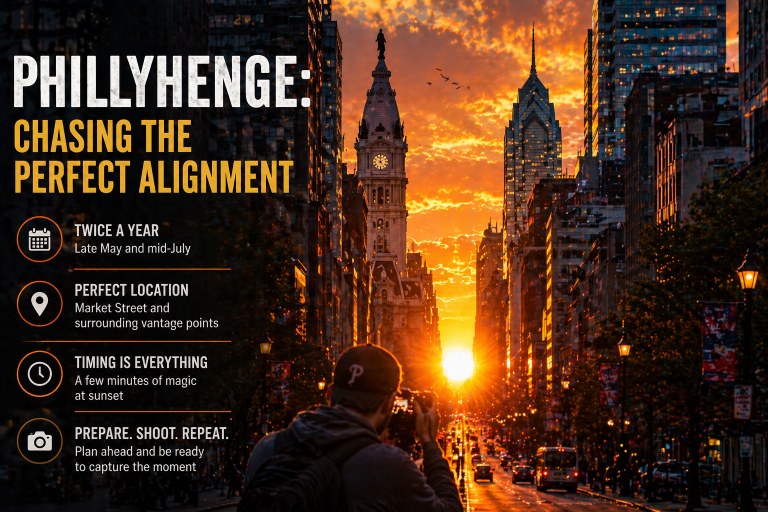
Twice a year, something special happens on the streets of Philadelphia. As the sun sets, it aligns perfectly with the city’s east–west grid, casting a glowing corridor of light down the streets. The result is a fleeting but powerful visual phenomenon known as Phillyhenge.
For photographers, it is part science, part timing, and part patience. And while the concept sounds simple, capturing it well is anything but.
What Is Phillyhenge?
Phillyhenge occurs when the setting sun lines up with Philadelphia’s grid system, most notably along Market Street. For a few brief minutes, the sun sits perfectly centered between rows of buildings, creating a dramatic vanishing point of light.
The effect is similar to Manhattanhenge in New York, but Philadelphia’s version feels a bit more accessible and, in many ways, more intimate. The city’s scale allows for a wider variety of vantage points and creative interpretations.
When Does Phillyhenge Happen?
Phillyhenge typically occurs twice a year, around late May and again in mid-July. While exact dates vary slightly from year to year, photographers generally mark their calendars for a few days on either side of these windows to increase their chances of catching the perfect conditions.
Sunset timing is critical, so checking a reliable sunset calculator ahead of time is essential. Plan to be in position at least 30–45 minutes before sunset to scout your composition and adjust as needed.
Where to Shoot
Most photographers gravitate toward Market Street, particularly near intersections that offer a long, unobstructed view west. Areas around Philadelphia City Hall are especially popular, as the architecture adds a strong focal point to the composition.
That said, the best images often come from exploring beyond the obvious. Smaller cross streets, overpasses, or even elevated parking structures can provide unique angles and less crowded conditions. The key is finding a clean sightline where the sun can sit low between buildings without obstruction.
Timing Is Everything
Phillyhenge does not last long. The window for perfect alignment is often just a few minutes, which means preparation is critical. Arrive early, scout your position, and be ready to shoot continuously as the sun drops.
Cloud cover can make or break the shot. A completely overcast sky will obscure the effect, while partial clouds can enhance it by adding texture and color.
Gear and Settings
While you do not need specialized gear, a few choices can improve your results. A longer lens can compress the scene and make the sun appear larger, intensifying the visual impact. A wide-angle lens, on the other hand, allows you to incorporate more of the surrounding environment and foreground elements.
Exposure can be tricky. The brightness of the sun combined with darker buildings creates high contrast. Shooting in manual mode and bracketing exposures can help preserve detail in both highlights and shadows.
Silhouettes are also your friend. Pedestrians, vehicles, and street elements can add scale and storytelling when placed against the glowing light.
Crowd vs. Creativity
Phillyhenge has become increasingly popular, and with that comes crowds. Tripods line the sidewalks, and photographers compete for the same angles.
While it can feel chaotic, it also presents an opportunity. Instead of fighting for the exact same shot as everyone else, look for moments within the scene. The way people interact with the light, the movement of traffic, or reflections in windows can all lead to more original images.
Sometimes stepping a block away from the main cluster of photographers is all it takes to find something different.
Why It Still Matters
In an age where images are captured constantly and shared instantly, Phillyhenge stands out because it cannot be rushed or recreated. It requires being present at a specific time and place, paying attention, and waiting for the moment to unfold.
There is something grounding about that process. It reminds photographers that not everything can be controlled or edited later. Some images still depend on timing, awareness, and a bit of luck.
Phillyhenge is more than just a visual trick of light. It is a reminder of why many photographers picked up a camera in the first place—to chase moments that are brief, unpredictable, and worth the effort.
And when everything comes together at just the right moment, even for a few seconds, the result can be unforgettable.